01
Line-of-sight check first
Because a tree is not an alignment problem.
Home/DStv services/Dish alignment
Dish alignment
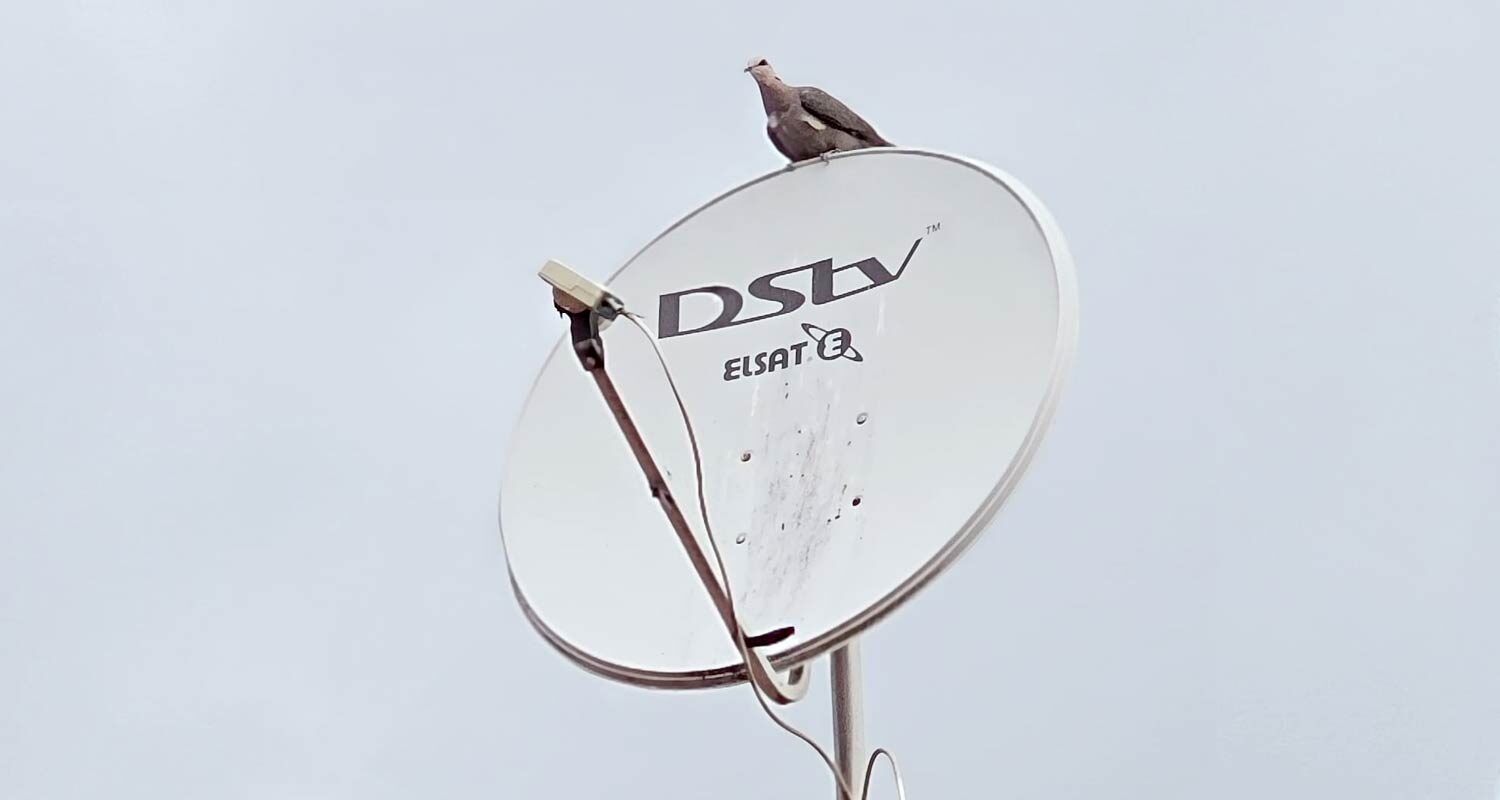
A satellite dish points at an object 36 000km above the equator. The tolerance is small, and a dish nudged out of line by wind, a storm or a ladder will pixelate, break up and eventually stop working entirely.
Your satellite dish is aimed at a specific communications satellite in geostationary orbit, roughly 36 000 kilometres above the equator. It is a small target at an enormous distance, and the angular tolerance for a clean lock is correspondingly tight.
Move the dish by a couple of degrees — which a strong wind, a hailstorm, a bird, or a ladder leaned carelessly against it will comfortably do — and you will still receive signal. That is the trap. It will still work, mostly, on a clear day. But the margin is gone, and the first real rain will take the picture away.
So realignment is not just about getting a picture back. It is about restoring the margin, so that the installation has enough headroom to keep working through weather. That is why we align on both signal strength and signal quality, and why we optimise rather than simply accepting the first lock we find.
The detail
More things than you would expect.
The most common cause. A dish is a sail. Sustained high wind, particularly on a poorly secured bracket, will move it.
The bracket bolts loosen over years, or the bracket itself corrodes. The dish then moves gradually rather than suddenly, and the signal degrades slowly.
A dish arm is an excellent perch, and a heavy bird landing on the LNB arm repeatedly will eventually shift things.
Painters, roofers and satellite installers all lean ladders against convenient things. A dish is a convenient thing.
Not strictly an alignment problem, but it produces identical symptoms. A tree that was small five years ago is not small now, and it is between your dish and the satellite.
A dish that was aligned by eye rather than with a meter never had any margin to begin with. It works until the first storm and then it does not.
What you get
Precise, and permanent.
01
Because a tree is not an alignment problem.
02
A loose bracket will simply move again.
03
Both readings, optimised, not just locked.
04
The often-forgotten third axis, and it matters.
05
So the dish stays where we put it.
06
Including the weak transponders that fail first.
Included
Done properly, so it lasts.
Line-of-sight assessmentTrees, buildings and new obstructions
Mounting and bracket inspectionTightened, or replaced if corroded
Elevation, azimuth and skewAll three axes, optimised
Signal quality maximisedNot just strength — this is what gives you rain margin
Connector and LNB checkBecause a bad LNB will look like bad alignment
Complete channel testEvery channel confirmed stable
Our process
01
A storm? Building work? Or has it degraded slowly over months?
02
Before we touch the alignment itself.
03
Elevation, azimuth and skew, optimised for quality.
04
So it stays aligned through the next storm.
FAQ
The things people actually ask us on the phone, answered straight.
WhatsApp us the make, the screen size and a short video of what the TV is doing. We can usually narrow the fault down before a technician is even dispatched.
WhatsApp 068 348 0078If the picture pixelates or breaks up, particularly in weather that never used to affect it, and especially if this started after a storm or building work, alignment is a strong suspect. Losing channels gradually over months more often points at the LNB.
You can try, and people do. The difficulty is that without a meter you are optimising for a picture rather than for signal quality, and a picture appears well before the alignment is actually optimal. That means you end up with no margin, and the first rain takes it away again.
Usually under an hour, including the line-of-sight check, the mounting inspection, the alignment itself and a full channel test.
Skew is the rotation of the LNB in its holder, and it aligns the LNB with the polarisation of the satellite signal. It is the axis most often ignored by casual installers, and getting it wrong costs you signal quality even when elevation and azimuth are perfect.
Wind and storms are the most common cause. Also worth considering: has anyone had a ladder up recently? Has a tree grown? Has a neighbour built something? All of these produce identical symptoms.
It will improve it substantially if the alignment was the problem. A properly optimised dish has margin — enough surplus signal quality to keep working through rain that would kill a marginal installation. If the LNB is also degraded, that needs replacing too.
Book a TV technician
If it started after a storm, it is probably alignment. We will re-point it properly and give you back your rain margin.
Satellite dish alignment across Gauteng
Contact